Benchmarking Best Practices in Maintenance Management

This concise and easy to use book provides a framework for managing maintenance with options that allow decision makers to select the most successful ways to manage their businesses.
 TABLE OF CONTENTS
 It has been said that:
To manage, you must have controls.
To have controls, you must have measurement.
To have measurement, you must have information.
To have information, you must collect data.
Data...information...facts. Whatever term you use, you need knowledge to make good decisions.
The goal of a computerized maintenance management system (CMMS) is to produce quality data to help you make good decisions.
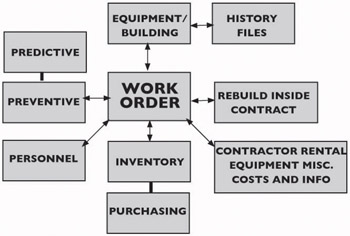
Even as a company implements a CMMS, data collection begins. Consider the various modules that make up a comprehensive CMMS:
Equipment
Inventory
Purchasing
Personnel
Preventive maintenance
Predictive maintenance
Work order
Contractor
Rebuilds
The data for reporting in a CMMS is derived from accurate data input into all of the CMMS modules.
Figure 9-1 shows the basic relationship of these modules to one another. The relationship of some of the modules will be discussed in the following section.
Equipment. To use this module properly, you must identify each piece of equipment or facility location that you want to track for costs and repairs. For example, you need the financial information stored in the equipment history when making repair/replacement and other cost decisions. Data provided by the other modules can determine the accuracy of the financial information.
Inventory. To use this module, you must identify the spare parts carried in each store at your facility. The data you need includes, but is not limited to:
Part number
Part description (short and extended)
On-hand, reserved, on-order, max-mm, etc.
Locations
Part-costing...