Benchmarking Best Practices in Maintenance Management
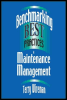
This concise and easy to use book provides a framework for managing maintenance with options that allow decision makers to select the most successful ways to manage their businesses.
 TABLE OF CONTENTS
 In today s competitive markets, companies must investigate every potential business opportunity that might turn into a competitive advantage. Companies that make the most of the tools they use to do business will be dominant in their respective marketplaces. One set of tools that bears close examination is information systems, the computerized tools that companies use to help monitor and control their businesses.
A discussion of every kind of information system available to a business is beyond the scope of this text. However, space does allow descriptions of several common information systems and their effective uses.
The most common systems used in business today include the following:
MRPII and MES systems help companies manage the financial, manufacturing, and distribution aspects of their business. Manufacturing resources planning (MRPII) systems are evolving into manufacturing execution systems (MES). In the future, MES systems likely will evolve into enterprise resource planning (ERP) systems, the integration of all aspects of a business into a single, comprehensive system.
CMMS (computerized maintenance management systems) and EAM (Enterprise Asset Management Systems) help companies manage the condition of the capital equipment they use to produce products or provide services. These systems can track information about the equipment and also schedule routine and preventive maintenance. Using maintenance information, companies can make objective repair-or-replace decisions and ultimately track total life-cycle costs of capital assets.
Shop-floor control systems help companies plan and track the progress of products through a manufacturing process.