Cam Design and Manufacturing Handbook

Ronald G. Mosier
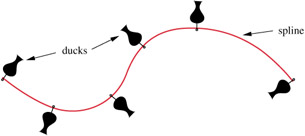
In the days before computers and computer-aided design, draftsmen wanting to draw a "fair" curve through prescribed points would use a spline, a thin rod made of some flexible material such as bamboo. Weights, called ducks, would anchor the spline so that it passed over the points, as shown in Figure 5-1. The spline would assume an overall shape that would minimize its strain energy subject to the constraints caused by the ducks. The draftsman could then trace the shape of the rod to get a smooth curve through the points.
Mathematical splines are an attempt to imitate this tool. As frequently happens, especially when the computer is involved, the imitators far exceed the original in versatility and in usefulness. This chapter explores how the engineer can use mathematical splines to design cams. Section 5.1 describes the classical splines, the closest imitators of the draftsman's spline. One of these, the cubic spline, is still the most commonly used of the mathematical splines. Section 5.2 discusses the general polynomial spline and Section 5.3 enlarges the engineer's spline toolbox by introducing B-splines and Section 5.4 discusses Bezier curves. A discussion of knot placement follows in Section 5.5. Knots are the mathematical version of the ducks. Section 5.6 introduces periodic splines and Section 5.7 trigonometric and rational splines. Section 5.8 summarizes everything and provides a list of advantages and disadvantages of various splines. From now on the term spline will be used to...