Cam Design and Manufacturing Handbook

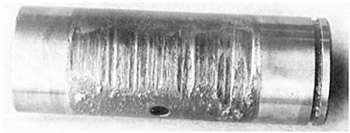
When (clean) surfaces such as those shown in Figure 12-1 (p. 338) are pressed against one another under load, some of the asperities in contact will tend to adhere to one another due to the attractive forces between the surface atoms of the two materials.[4] As sliding between the surfaces is introduced, these adhesions are broken, either along the original interface or along a new plane through the material of the asperity peak. In the latter case, a piece of part A is transferred to part B, causing surface disruption and damage. Sometimes, a particle of one material will be broken free and become debris in the interface, which can then scratch the surface and plough furrows in both parts. This damage is sometimes called scoring or scuffing [2] of the surface. Figure 12-5 shows an example of a shaft failed by adhesive wear in the absence of adequate lubricant.[5]
The original adhesion theory postulated that all asperity contacts would result in yielding and adhesion due to the high stresses present. It is now believed that in most cases of contact, especially with repeated rubbing, only a small fraction of the asperity contacts actually result in yielding and adhesion; elastic deformations of the asperities also play a significant role in the tractive forces (friction) developed at the interface.[6]
Contaminants Adhesive bonding at the asperities can only occur if the material is clean and free of contaminants.