Circuit Analysis I with MATLAB Computing and Simulink/SimPowerSystems Modeling
Chapter 1: Basic Concepts and Definitions

This chapter begins with the basic definitions in electric circuit analysis. It introduces the concepts and conventions used in introductory circuit analysis, the unit and quantities used in circuit analysis, and includes several practical examples to illustrate these concepts. Throughout this text, a left justified horizontal bar will denote the beginning of an example, and a right justified horizontal bar will denote the end of the example. These bars will not be shown whenever an example begins at the top of a page or at the bottom of a page. Also, when one example follows immediately after a previous example, the right justified bar will be omitted.

1.1 The Coulomb

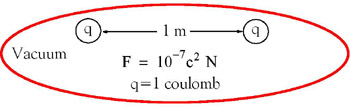
Two identically charged (both positive or both negative) particles possess a charge of one coulomb when being separated by one meter in a vacuum, repel each other with a force of 10 ?7c 2 newton where c = velocity of light ? 3 10 8 m/s. The definition of coulomb is illustrated in Figure 1.1.


Figure 1.1: Definition of the coulomb

The coulomb, abbreviated as C, is the fundamental unit of charge. In terms of this unit, the charge of an electron is 1.6 10 ?19 C and one negative coulomb is equal to 6.24 10 18 electrons. Charge, positive or negative, is denoted by the letter q or Q.

1.2 Electric Current and Ampere

Electric current i at a specified point and flowing in a specified direction is...

UNLIMITED FREE
ACCESS
TO THE WORLD'S BEST IDEAS

SUBMIT
Already a GlobalSpec user? Log in.

This is embarrasing...

An error occurred while processing the form. Please try again in a few minutes.

Customize Your GlobalSpec Experience

Category: Capacitance Testers
Finish!
Privacy Policy

This is embarrasing...

An error occurred while processing the form. Please try again in a few minutes.