Circuit Analysis I with MATLAB Computing and Simulink/SimPowerSystems Modeling
The principle of superposition states that the response (a desired voltage or current) in any branch of a linear circuit having more than one independent source can be obtained as the sum of the responses caused by each independent source acting alone with all other independent voltage sources replaced by short circuits and all other independent current sources replaced by open circuits.
| Note | Dependent sources (voltage or current) must not be superimposed since their values depend on the voltage across or the current through some other branch of the circuit. Therefore, all dependent sources must always be left intact in the circuit while superposition is applied. |
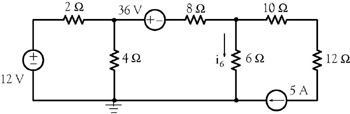
In the circuit of Figure 3.56, compute i 6 by application of the superposition principle.
Solution:
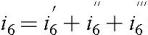
Let i ? 6 represent the current due to the 12 V source acting alone, i ? 6 the current due to the 36 V source acting alone, and i ?? 6 the current due to the 5 A source acting alone. Then, by the principle of superposition,
First, to find i ? 6 we short the 36 V voltage source and open the 5 A current source. The circuit then reduces to that shown in Figure 3.57.
Applying Thevenin's theorem at points x and y of Figure 3.57, we obtain the circuit of Figure 3.58...