Circuit Analysis I with MATLAB Computing and Simulink/SimPowerSystems Modeling

Chapter 4: Introduction to Operational Amplifiers

This chapter is an introduction to amplifiers. It discusses amplifier gain in terms of decibels (dB) and provides an overview of operational amplifiers, their characteristics and applications. Numerous formulas for the computation of the gain are derived and several practical examples are provided.

4.1 Signals

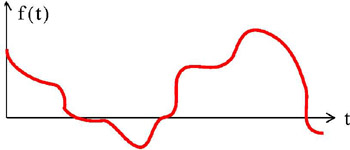
A signal is any waveform that serves as a means of communication. It represents a fluctuating electric quantity, such as voltage, current, electric or magnetic field strength, sound, image, or any message transmitted or received in telegraphy, telephony, radio, television, or radar. A typical signal which varies with time is shown in figure 4.1 where f(t) can be any physical quantity such as voltage, current, temperature, pressure, and so on.


Figure 4.1: A signal That changes with time

4.2 Amplifiers

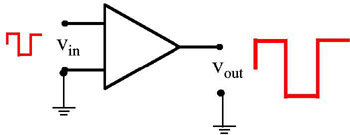
An amplifier is an electronic circuit which increases the magnitude of the input signal. The symbol of a typical amplifier is a triangle as shown in Figure 4.2.


Figure 4.2: Symbol for electronic amplifier

An electronic (or electric) circuit which produces an output that is smaller than the input is called an attenuator. A resistive voltage divider is a typical attenuator.

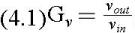
An amplifier can be classified as a voltage amplifier, current amplifier, or power amplifier. The gain of an amplifier is the ratio of the output to the input. Thus for a voltage amplifier,


The current gain G i and power gain G p are defined similarly.

Note 1: Throughout this text, the common (base...

UNLIMITED FREE
ACCESS
TO THE WORLD'S BEST IDEAS

SUBMIT
Already a GlobalSpec user? Log in.

This is embarrasing...

An error occurred while processing the form. Please try again in a few minutes.

Customize Your GlobalSpec Experience

Category: Amplifier and Comparator Chips
Finish!
Privacy Policy

This is embarrasing...

An error occurred while processing the form. Please try again in a few minutes.