Circuit Analysis I with MATLAB Computing and Simulink/SimPowerSystems Modeling

This chapter discusses the natural response of electric circuits. The term natural implies that there is no excitation in the circuit, that is, the circuit is source free, and we seek the circuit's natural response. The natural response is also referred to as the transient response.
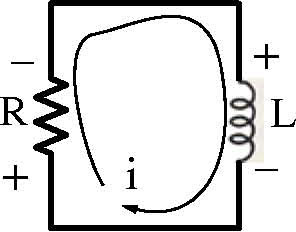
Let us find the natural response of the circuit of Figure 9.1 where the desired response is the current i, and it is given that at t = 0, i = I 0, that is, the initial condition is i(0) = I 0.
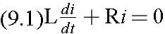
Application of KVL yields
or
Here, we seek a value of i which satisfies the differential equation of (9.1), that is, we need to find the natural response which in differential equations terminology is the complementary function. As we know, two common methods are the separation of variables method and the assumed solution method. We will consider both.
Separation of Variables Method
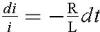
Rearranging (9.1), so that the variables i and t are separated, we obtain
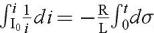
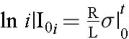
Next, integrating both sides and using the initial condition, we obtain
where ? is a dummy variable. Integration yields
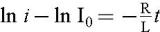
or
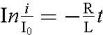
or
Recalling that x = lny implies y = e x, we obtain
Substitution of (9.2) into (9.1) yields 0 = 0 and that at t = 0, i(0) = I 0. Thus, both the...