Circuit Analysis I with MATLAB Computing and Simulink/SimPowerSystems Modeling
3.10: Circuits with Non-Linear Devices

3.10 Circuits with Non-Linear Devices

Most electronic circuits contain non-linear devices such as diodes and transistors whose i ? v (current-voltage) relationships are non-linear. However, for small signals (voltages or currents) these circuits can be represented by linear equivalent circuit models. A detailed discussion of these is beyond the scope of this text; however we will see how operational amplifiers can be represented by equivalent linear circuits in the next chapter.

If a circuit contains only one non-linear device, such as a diode, and all the other devices are linear, we can apply Thevenin's theorem to reduce the circuit to a Thevenin equivalent in series with the non-linear element. Then, we can analyze the circuit using a graphical solution. The procedure is illustrated with the following example.

Example 3.13

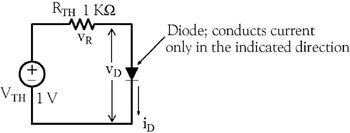
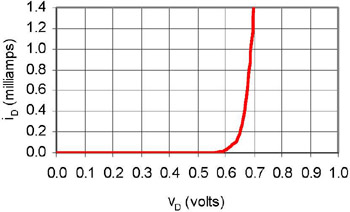
For the circuit of Figure 3.65, the i ? v characteristics of the diode D are shown in Figure 3.66. We wish to find the voltage v D across the diode and the current i D through this diode using a graphical solution.


Figure 3.65: Circuit for Example 3.13

Figure 3.66: Diode i ? v characteristics

Solution:


or


or


We observe that (3.61) is an equation of a straight line and the two points are obtained from it by first letting v D =0, then, i D =0. We obtain the straight line shown in Figure 3.67 that is plotted on the same graph as the given diode i ? v characteristics.

UNLIMITED FREE
ACCESS
TO THE WORLD'S BEST IDEAS

SUBMIT
Already a GlobalSpec user? Log in.

This is embarrasing...

An error occurred while processing the form. Please try again in a few minutes.

Customize Your GlobalSpec Experience

Category: Diodes
Finish!
Privacy Policy

This is embarrasing...

An error occurred while processing the form. Please try again in a few minutes.