Circuit Analysis I with MATLAB Computing and Simulink/SimPowerSystems Modeling
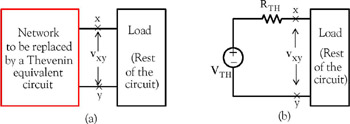
This theorem is perhaps the greatest time saver in circuit analysis, especially in electronic [*] circuits. It states that we can replace a two terminal network by a voltage source v TH in series with a resistance R TH as shown in Figure 3.26.
The network of Figure 3.26 (b) will be equivalent to the network of Figure 3.26 (a) if the load is removed in which case both networks will have the same open circuit voltages v xy and consequently,
Therefore,
The Thevenin resistance R TH represents the equivalent resistance of the network being replaced by the Thevenin equivalent, and it is found from the relation
where i SC stands for short-circuit current.
If the network to be replaced by a Thevenin equivalent contains independent sources only, we can find the Thevenin resistance R TH by first shorting all (independent) voltage sources, opening all (independent) current sources, and calculating the resistance looking into the direction that is opposite to the load when it has been disconnected from the rest of the circuit at terminals x and y.
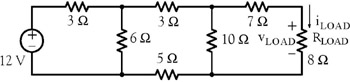
Use Thevenin's theorem to find i LOAD and v LOAD for the circuit of Figure 3.27.
Solution:
We will apply Thevenin's theorem twice; first at terminals x and y and then at x ? and y ?