Civil Engineering Formulas

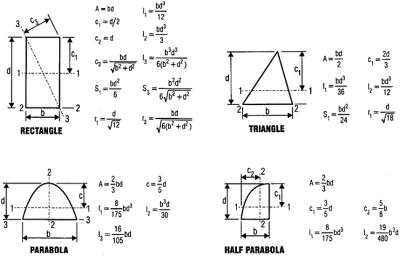
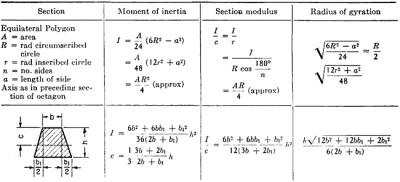
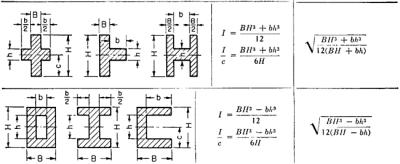
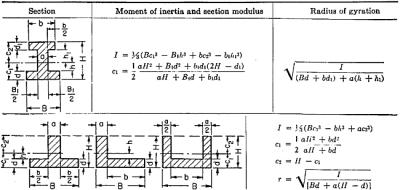
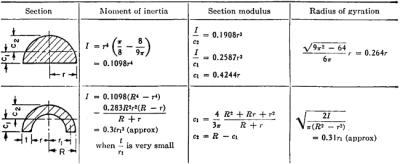
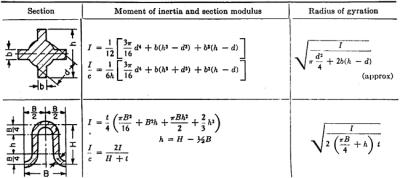
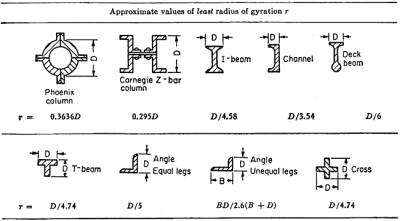
In analyzing beams of various types, the geometric properties of a variety of cross-sectional areas are used. Figure 2.1 gives equations for computing area A, moment of inertia I, section modulus or the ratio S = I/c, where c = distance from the neutral axis to the outermost ber of the beam or other member. Units used are inches and millimeters and their powers. The formulas in Fig. 2.1 are valid for both USCS and SI units.
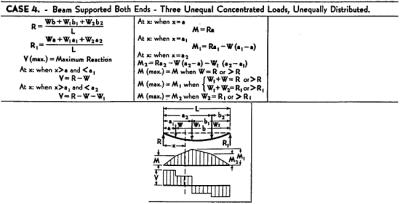
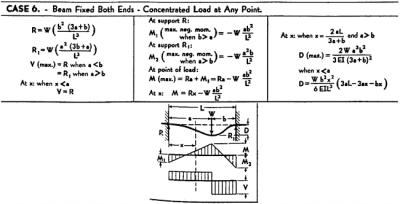
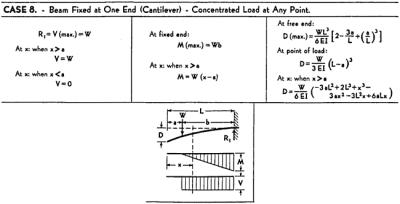
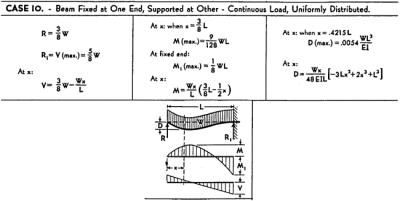
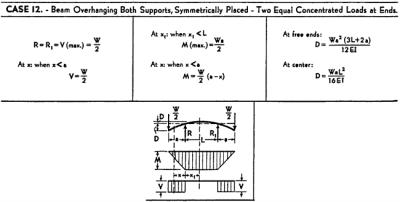
Handy formulas for some dozen different types of beams are given in Fig. 2.2. In Fig. 2.2, both USCS and SI units can be used in any of the formulas that are applicable to both steel and wooden beams. Note that W = load, lb (kN); L = length, ft (m); R = reaction, lb (kN); V = shear, lb (kN); M = bending moment, lb ft (N m); D = deflection, ft (m); a = spacing, ft (m); b = spacing, ft (m); E = modulus of elasticity, lb/in 2 (kPa); I = moment of inertia, in 4 (dm 4); < = less than; > = greater than.
Figure 2.3 gives the elastic-curve equations for a variety...