PROPERTIES IN THE HARDENED STATE
Strength is a property of concrete that nearly always is of concern. Usually, it is determined by the ultimate strength of a specimen in compression, but sometimes flexural or tensile capacity is the criterion. Because concrete usually gains strength over a long period of time, the compressive strength at 28 days is commonly used as a measure of this property.
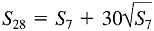
The 28-day compressive strength of concrete can be estimated from the 7-day strength by a formula proposed by W. A. Slater:
where S 28 = 28-day compressive strength, lb/in 2 (MPa), and S 7 = 7-day strength, lb/in 2 (MPa).
Concrete may increase significantly in strength after 28 days, particularly when cement is mixed with fly ash. Therefore, specification of strengths at 56 or 90 days is appropriate in design.
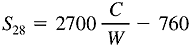
Concrete strength is influenced chiefly by the water/cement ratio; the higher this ratio is, the lower the strength. The relationship is approximately linear when expressed in terms of the variable C/W, the ratio of cement to water by weight. For a workable mix, without the use of water reducing admixtures,
Tensile strength of concrete is much lower than compressive strength and, regardless of the types of test, usually has poor correlation with  . As determined in flexural tests, the tensile strength (modulus of rupture not the true strength) is about 7
  for the higher strength concretes and 10
  for the lower strength concretes.
Modulus of elasticity...


 TABLE OF CONTENTS