Civil Engineering Formulas

Chapter 3: COLUMN FORMULAS

GENERAL CONSIDERATIONS

Columns are structural members subjected to direct compression. All columns can be grouped into the following three classes:

  1. Compression blocks are so short (with a slenderness ratio that is, unsupported length divided by the least radius of gyration of the member below 30) that bending is not potentially occurring.

  2. Columns so slender that bending under load is a given are termed long columns and are defined by Euler s theory.

  3. Intermediate-length columns, often used in structural practice, are called short columns.

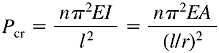
Long and short columns usually fail by buckling when their critical load is reached. Long columns are analyzed using Euler s column formula, namely,


In this formula, the coefficient n accounts for end conditions. When the column is pivoted at both ends, n = 1; when one end is fixed and the other end is rounded, n = 2; when both ends are fixed, n = 4; and when one end is fixed and the other is free, n = 0.25. The slenderness ratio separating long columns from short columns depends on the modulus of elasticity and the yield strength of the column material. When Euler s formula results in ( P cr/ A)> S y, strength instead of buckling causes failure, and the column ceases to be long. In quick estimating numbers, this critical slenderness ratio falls between 120 and 150. Table 3.1 gives additional column data based on Euler s formula.

Table 3.1: Strength of Round-Ended Columns...

UNLIMITED FREE
ACCESS
TO THE WORLD'S BEST IDEAS

SUBMIT
Already a GlobalSpec user? Log in.

This is embarrasing...

An error occurred while processing the form. Please try again in a few minutes.

Customize Your GlobalSpec Experience

Category: Columns
Finish!
Privacy Policy

This is embarrasing...

An error occurred while processing the form. Please try again in a few minutes.