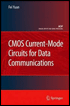
CMOS Current-Mode Circuits for Data Communications
The main function of serial link transmitters includes serialization of parallel data, pre-emphasis to compensate for the high-frequency loss of wire channels, conveying either voltages or currents of a sufficiently large amplitude and a proper slew rate to channels, and providing a matching impedance to minimize the reflection at the near end of the channels. This chapter is concerned with the design of current-mode transmitters for serial links. Section 5.1 presents an overview of data links and compares the pros and cons of parallel and serial data links. Section 5.2 deals with the design of multiplexers. The architecture of various multiplexers and their advantages and limitations are examined in detail. Section 5.3 is devoted to the design of serial link drivers. Both voltage-mode and current-mode drivers, and their advantages and limitations, are examined. Section 5.4 deals with pre-emphasis for high-frequency loss of channels. Finite-impulse response (FIR)-based pre-emphasis schemes, their advantages and disadvantages, and practical implementations are investigated. An emphasis is given to the silicon area and power consumption of pre-emphasis blocks of transmitters. The design of serial-link transmitters is investigated in Section 5.5. The chapter is summarized in Section 5.6
Point-to-point data links can be loosely classified into source-synchronized parallel links and serial links. The former transmit data and clock using separate physical links, whereas the latter convey both the data and clock using the same physical link, more specifically, clock is embedded in the transition of data streams. The typical configuration of source synchronized parallel data links...