CMOS Current-Mode Circuits for Data Communications
6.4: Data Recovery Using Current Integration

6.4 Data Recovery Using Current Integration

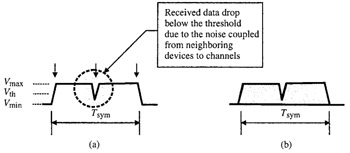
Both phase-picking and phase-tracking suffer from a common drawback that high-frequency disturbances coupled to the channel of data links may drive the amplitude of the received data at the time instants where sampling takes place beyond the threshold voltage, resulting in an erroneous result, as illustrated graphically in Fig. 6.72.


Figure 6.72: (a) A large transient disturbance at sampling point exceeds the threshold voltage, giving rise to an erroneous result. (b) If the logic state is represented by the area under the waveform rather than the amplitude of the waveform, transient disturbances will have a little impact on the logic state.

An integrator is a low-pass filter with its pole at s = 0. The amplitude of the transfer function of the integrator drops with frequency at the rate of -20dB/decade. It is capable of filtering out transient noise. The output of the integrator at the end of the integration period is the area under the voltage waveform. Transient noise that causes the input to exceed the threshold voltage of logic states, has a little effect on the final value of the integrating capacitor, as long as the duration of the transient noise is much smaller than the symbol time [186]. An integrating receiver integrates the incoming data signal over a fixed period of time called integration time, which is a portion of the symbol time. Data are recovered from the value of the output voltage of the integrator at the end of...

UNLIMITED FREE
ACCESS
TO THE WORLD'S BEST IDEAS

SUBMIT
Already a GlobalSpec user? Log in.

This is embarrasing...

An error occurred while processing the form. Please try again in a few minutes.

Customize Your GlobalSpec Experience

Category: Analog-to-Digital Converters
Finish!
Privacy Policy

This is embarrasing...

An error occurred while processing the form. Please try again in a few minutes.