Identification
Users of instruments and control systems need some method for identifying equipment so they can manage the engineering, purchasing, installation, and maintenance of such systems. Therefore, one of the key requirements of measurement and control systems is that every device have a unique tag number. An installation's guidelines for these tag numbers should either conform to a company standard or to ISA-5.1 1984 (R1992). Either way, these tag guidelines should be uniform throughout the plant.
The practitioner is advised that, per ISA-5.1 1984 (R1992), identification of instruments is according to function and not construction. Thus, a differential pressure transmitter across an orifice plate in a flow measuring application would be tagged as "FT," not "PDT."
According to the ISA standards, the typical tag number consists of two parts (see figure 2-1): a functional identification and a loop number (e.g., TIC-103). The functional identification consists of a first letter (designating the measured or initiating variable; for example, F for Flow, T for Temperature, etc.) and one or more succeeding letters (identifying the functions performed; for example, I for Indicating, T for Transmitter, C for Controller, V for Valve, etc.). For example, a temperature indicating controller is identified as TIC, a flow transmitter as FT; a temperature recorder as TR, a level controller as LC, and so on.
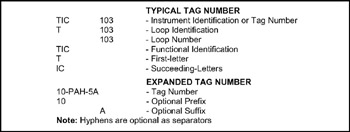 Figure 2-1: Tag Numbers
 The loop number is unique to each loop and is typically common to all instruments within a loop. For example, if in a loop, a transmitter FT is measuring flow, and...


 TABLE OF CONTENTS