Condensed Handbook of Measurement and Control, 3rd Edition

Calibration of control equipment is a key maintenance activity. It is needed to ensure that the accuracy designed into the control system as a whole is maintained.
Typically, this activity is performed in a calibration shop, where most of the calibrating equipment is located. The quality of the calibration shop, the quality and accuracy of the instruments used for calibration, and the calibration records kept for all instruments are important facets of calibration activities.
Calibration is performed in accordance with written procedures. It compares a measurement made by an instrument being tested to that of a more accurate instrument to detect errors in the instrument being tested. Errors are acceptable if they are within a permissible limit.
Instrument calibration should be done for all instruments prior to first use to confirm all settings. This can be done either by the equipment vendor (who will issue a calibration certificate with the instrument) or by the calibration shop at the plant upon receipt of the instrument. Vendors generally charge a fee for this activity.
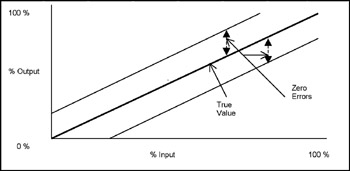
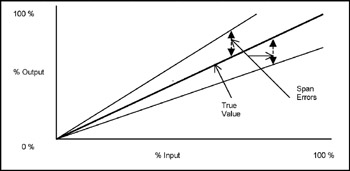
Most analog instruments have adjustable zeros and spans. In most cases, calibration consists of correcting the zero and span errors to an acceptable tolerance (see figure 17-1 and 17-2).
Typically, an instrument is checked at a number of points through its calibration range, i.e., from the lower end of its range (the zero point) to the upper end of its range. The zero point is a value assigned to...