Condensed Handbook of Measurement and Control, 3rd Edition

Enclosures, which include control panels and cabinets, house items of instrumentation and controls as well as their peripherals such as wiring, terminal blocks, power supplies, and the like. Enclosures are typically assembled in a panel assembly shop by professionals who should know in detail what the owner's requirements are. It is therefore important that the plant prepare a specification that covers the design, construction, assembly, testing, and shipping of the enclosure.
A typical specification should address the following topics: general requirements, documentation, fabrication, protection and rating, nameplates, electrical considerations, pneumatics, temperature and humidity control, inspection and testing, certification, and shipping. This chapter will address these topics.
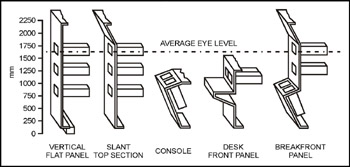
There are many type of control panels (see figure 12-1).
Vertical panels are simple in design and cost less than the others; they could be wall or floor mounted.
Slant-top section panels use their top segment typically to mount annunciators or semigraphic displays.
Consoles are used to facilitate operator access to push buttons and indicator lights.
Desk front panels are commonly used to provide an operator with a "look-over" capability.
Breakfront panels provide good access and improve aesthetics. They tend to be custom built and therefore cost more than regular panels.
One of the first rules in building control panels is to ensure that all electrical components comply with the requirements of the current edition of the electrical code in effect at the site and that they are approved by and bear the approval label of...