Control of Continuous Linear Systems

Chapter 4: Stability and the Root Locus

4.1 Stability

Definition 1

A system is stable if all its poles are located in the left half-plane (on the left-hand side of the imaginary axis), i.e., the real parts of all the poles are negative.

Observe that this definition is valid only for causal systems. One general condition of stability is the following.

Definition 2

If the impulse response of a continuous system has a finite number of local extrema (maxima or minima) and a finite number of discontinuities in any finite interval, then the system is stable if and only if:


exists and is finite, where g (t) represents the impulse response, which is equal to zero when t is negative for causal system.

The conditions on extrema and discontinuities are generally fulfilled by real-life systems.

In practice, the parameters of the model are obtained (i.e., estimated) from the available data, i.e., input output measurements. These measurements are always affected by measurement errors, which depend mainly on the precision of the sensors.

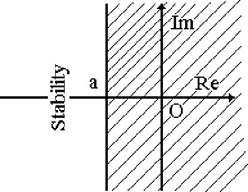
In order to take into account this uncertainty about the model parameters, we can consider the domain depicted in Figure 4.1 as the stability domain [1] ( Re ( poles) < a). Sometimes, restrictions on the damping are also imposed. These restrictions lead to the stability domain depicted in Figure 4.2 (see Problem 3.20). We may also impose restrictions on ? ? n. These restrictions lead to the domain depicted in Figure 4.3 (see Problem 3.20 again).


Figure 4.1: A restricted stability...

UNLIMITED FREE
ACCESS
TO THE WORLD'S BEST IDEAS

SUBMIT
Already a GlobalSpec user? Log in.

This is embarrasing...

An error occurred while processing the form. Please try again in a few minutes.

Customize Your GlobalSpec Experience

Category: IC Electronic Filters
Finish!
Privacy Policy

This is embarrasing...

An error occurred while processing the form. Please try again in a few minutes.