Control of Continuous Linear Systems

2.3: Laplace Transform Calculations

2.3 Laplace Transform Calculations

Problem 2.1

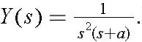
Calculate the inverse Laplace transform of the following function:


Solution 2.1

Let us consider the following Laplace transforms:


Their inverse Laplace transforms will be denoted by y 1( t) and y 2( t), respectively. It follows that:


Taking into account the fact that:


we derive:


Problem 2.2

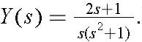
Calculate the inverse Laplace transform of the following function:


Solution 2.2

The poles (natural modes) of this function are:


Let us now calculate the residues associated with these singularities. The residue related to the pole p 1 = 0 is given by:


The residue associated with the pole p 2 = j is:


Finally, the residue associated with the pole p 3 = ? j is:


Therefore:


Problem 2.3

Calculate the inverse Laplace transform of the following function:


Solution 2.3

Let us calculate the roots of the denominator of this function. Observe that s = ?1 is a root. Therefore, we obtain:


Let us now determine the partial fraction expansion [5] of Y( s):


Multiplying both sides of this equation by ( s + 1) and setting s = ?1, we obtain:


Multiplying both sides of the equation by ( s + 2) and setting s = ?2, we obtain:


Now, proceeding as before for the pole s = ?5, we derive:


Finally, the partial fraction expansion of Y( s) is:


from which...

UNLIMITED FREE
ACCESS
TO THE WORLD'S BEST IDEAS

SUBMIT
Already a GlobalSpec user? Log in.

This is embarrasing...

An error occurred while processing the form. Please try again in a few minutes.

Customize Your GlobalSpec Experience

Category: IC Electronic Filters
Finish!
Privacy Policy

This is embarrasing...

An error occurred while processing the form. Please try again in a few minutes.