Control of Continuous Linear Systems

The main objective of transient and frequency analysis is to convey information about the process considered. For a given system:
the transfer function is equal to the Laplace transform of the impulse response, i.e.:
the transfer function is equal to the Laplace transform of the derivative of the step response, i.e.:
the frequency response is a function of the magnitude and argument of the transfer function, i.e.:
where the input is given by:
Transient and frequency analysis can be compared to a recruitment interview where applicants have to answer specific questions ("skilful" questioning). On the basis of the applicant's responses, the recruiter is "able" to evaluate the applicants and to select a qualified applicant for the position offered.
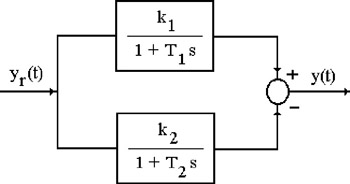
Consider the system depicted in Figure 3.1. Determine for what values of the gains k 1 and k 2 the derivative at the origin of the step response of the system is positive.
The Laplace transform of the step response is given by:
The inverse of this Laplace transform gives expressions for the step responses of the systems:
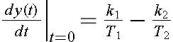
The derivative is given by:
At the origin, we obtain:
which is positive for:
Observe that for:
we obtain a non-minimum phase syste.
Determine the step response of the following system:
Calculate the steady-state error (position error).
The Laplace transform of the step response is given by:
A partial fraction expansion [1] of