Control of Continuous Linear Systems

Let us first consider a simple problem which illustrates the usefulness of feedback control in the presence of disturbances.
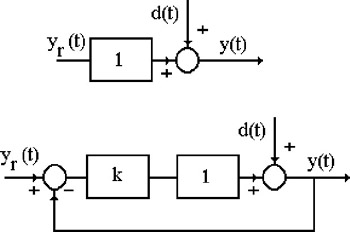
Consider a system with a unit transfer function and a disturbed measured output y ( t), and the same system compensated with a proportional regulator (see Figure 5.1). For a given input y r ( t), calculate the outputs of the open-loop and closed-loop systems.
The output of the open-loop system is equal to:
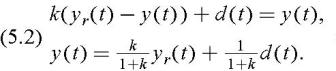
The output of the closed-loop system is given by:
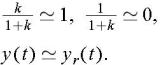
The effect of the disturbance on the system output has been reduced. For large values of the gain k, we derive:
The effect of the disturbance on the measured output is now negligible.
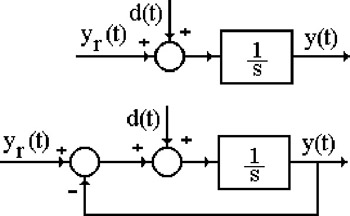
Consider the systems depicted in Figure 5.2. Analyze their behavior for y r ( t) = 0 and d ( t) = d 0.
For the open-loop system, we obtain:
where 1 ( t) represents the unit step. The output increases with time. Therefore, the integrator will saturate.
For the closed-loop system, we derive:
The closed-loop system prevents itself from driving the output to saturation.
Study the effect of a proportional controller on first- and second-order systems.
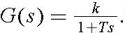
Let us first consider a first order system: The closed-loop transfer function is given by:
The closed-loop transfer function is given by: