Digital Circuit Analysis and Design with Simulink Modeling and Introduction to CPLDs and FPGAs, Second Edition

7.4: Karnaugh Maps

7.4 Karnaugh Maps

A Karnaugh map, henceforth referred to as K-map, is a matrix of squares. In general, a Boolean expression with n variables can be represented by a K-map of 2 n squares where each square represents a row of an equivalent truth table. A K-map provides a very powerful method of reducing Boolean expressions to their simplest forms.

7.4.1 K-map of Two Variables

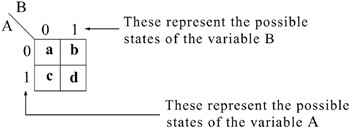
Figure 7.25 shows a two-variable K-map with four squares where each square represents one combination of the variables.


Figure 7.25: K-map of two variables

In figure 7.25,

  • square a represents the combination A=0 and B=0, that is, a ? AB

  • square b represents the combination A=0 and B=1, that is, b ? AB

  • square c represents the combination A=1 and B=0, that is, c ?A B

  • square d represents the combination A=1 and B=1, that is, d ?AB

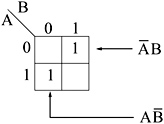
For example, the Boolean expression C= AB+A B can be shown in a K-map as indicated in Figure 7.26 where the 1s denote the conditions for which the Boolean expression is true (logical 1).


Figure 7.26: K-map for the Boolean expression C= AB+A B

For simplicity, we enter only 1 s l in the squares of a K-map and it is understood that all other empty squares contain 0s.

We can also derive a Boolean expression from a K-map. For example, from the K-map shown in Figure 7.27 we derive the Boolean expression Z= X

UNLIMITED FREE
ACCESS
TO THE WORLD'S BEST IDEAS

SUBMIT
Already a GlobalSpec user? Log in.

This is embarrasing...

An error occurred while processing the form. Please try again in a few minutes.

Customize Your GlobalSpec Experience

Category: Squares
Finish!
Privacy Policy

This is embarrasing...

An error occurred while processing the form. Please try again in a few minutes.