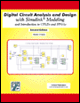
Digital Circuit Analysis and Design with Simulink Modeling and Introduction to CPLDs and FPGAs, Second Edition
Chapter 8: Sequential Logic Circuits

This chapter is an introduction to sequential logic circuits. These are logic circuits where the output(s) depend not only on the input(s) but also on previous states of the output(s). It begins with a discussion of the different types of flip flops, and continues with the analysis and design of binary counters, registers, ring counters, and ring oscillators.

8.1 Introduction to Sequential Circuits

In the previous chapter a combinational logic circuit was defined as a logic circuit whose output(s) are strictly a function of its inputs. A sequential circuit is a logic circuit whose output(s) is a function of its input(s) and also its internal state(s). The (internal) state of a sequential logic circuit is either a logic 0 or a logic 1, and because of its ability to maintain a state, it is also called a memory circuit. Generally, sequential circuits have two outputs one of which is the complement of the other and multivibrators [*] fall into this category. Sequential circuits may or may not include logic gates.

Flip flops, also known as bistable multivibrators, are electronic circuits with two stable outputs one of which is the complement of the other. The outputs will change only when directed by an input command.

There are 4 types of flip flops and these are listed below.

  1. Set-Reset (SR) or Latch

  2. D Type (Data or Delay)

  3. JK

  4. T (Toggle)

[*] For a thorough discussion on multivibrator circuits, please refer to Electronic Devices...

UNLIMITED FREE
ACCESS
TO THE WORLD'S BEST IDEAS

SUBMIT
Already a GlobalSpec user? Log in.

This is embarrasing...

An error occurred while processing the form. Please try again in a few minutes.

Customize Your GlobalSpec Experience

Category: Logic Counters
Finish!
Privacy Policy

This is embarrasing...

An error occurred while processing the form. Please try again in a few minutes.