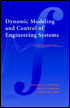
Dynamic Modeling and Control of Engineering Systems, Third Edition
Chapter 1: Introduction

LEARNING OBJECTIVES FOR THIS CHAPTER

  • 1 1 To work comfortably with the engineering concept of a system and its interaction with the environment through inputs and outputs.

  • 1 2 To distinguish among various types of mathematical models used to represent and predict the behavior of systems.

  • 1 3 To recognize through (T-type) variables and across (A-type) variables when examining energy transfer within a system.

  • 1 4 To recognize analogs between corresponding energy-storage and energy-dissipation elements in different types of dynamic systems.

  • 1 5 To understand the key role of energy-storage processes in system dynamics.

1.1 SYSTEMS AND SYSTEM MODELS

The word system has become very popular in recent years. It is used not only in engineering but also in science, economics, sociology, and even in politics. In spite of its common use (or perhaps because of it), the exact meaning of the term is not always fully understood. A system is defined as a combination of components that act together to perform a certain objective. A little more philosophically, a system can be understood as a conceptually isolated part of the universe that is of interest to us. Other parts of the universe that interact with the system comprise the system environment, or neighboring systems.

All existing systems change with time, and when the rates of change are significant, the systems are referred to as dynamic systems. A car riding over a road can be considered as a dynamic system (especially on a crooked or bumpy road). The limits of...

UNLIMITED FREE
ACCESS
TO THE WORLD'S BEST IDEAS

SUBMIT
Already a GlobalSpec user? Log in.

This is embarrasing...

An error occurred while processing the form. Please try again in a few minutes.

Customize Your GlobalSpec Experience

Category: Flywheel Power Systems
Finish!
Privacy Policy

This is embarrasing...

An error occurred while processing the form. Please try again in a few minutes.