Dynamic Modeling and Control of Engineering Systems, Third Edition
2.3: ROTATIONAL-MECHANICAL SYSTEMS

2.3 ROTATIONAL-MECHANICAL SYSTEMS

Corresponding respectively to the translational elements mass, spring, and damping are rotational inertia, rotational spring, and rotational damping. These rotational elements are used in the modeling of systems in which each element rotates about a single nonaccelerating axis.

2.3.1 Rotational Inertias

An ideal inertia, depicted schematically in free-body diagram form in Fig. 2.13, moves in relation to a nonaccelerating rotational frame of reference, which is usually taken to be the earth (ground). However, the frame of a steadily rotating space vehicle, for instance, could be used as a reference.


Figure 2.13: Free-body diagram of am ideal rotational inertia.

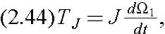
The elemental equation for an ideal inertia J, based on Newton s second law for rotational motion, is


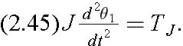
where ? 1 is the angular velocity of the inertia relative to the ground reference and T J is the sum of all the external torques (twisting moments) applied to the inertia. Because ? 1= d ? 1 /dt, the variation of ? is related to T J by


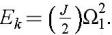
The kinetic energy stored in an ideal rotational inertia is


Hence it is designated as an A-type element, storing energy as a function of the square of its A variable ? 1 .

The response of an inertia to an applied torque T J is analogous to the response of a mass to an applied force F m . It takes time for angular velocity, kinetic energy, and angular displacement to accumulate after...

UNLIMITED FREE
ACCESS
TO THE WORLD'S BEST IDEAS

SUBMIT
Already a GlobalSpec user? Log in.

This is embarrasing...

An error occurred while processing the form. Please try again in a few minutes.

Customize Your GlobalSpec Experience

Category: Mechanical Brakes
Finish!
Privacy Policy

This is embarrasing...

An error occurred while processing the form. Please try again in a few minutes.