Dynamic Modeling and Control of Engineering Systems, Third Edition

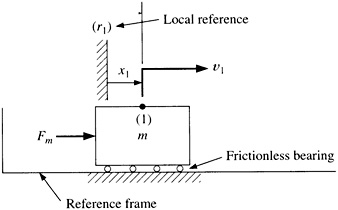
Analysis of mechanical systems is based on the principles embodied in Newton s laws of motion and the principle of compatibility (no gaps between connected elements). An ideal mass, depicted schematically in free-body diagram form in Fig. 2.2, moves in relation to a nonaccelerating frame of reference, which is usually taken to be a fixed point on the earth (ground) however, the frame of a nonaccelerating vehicle could be used instead.
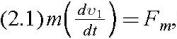
The elemental equation for an ideal mass m, based on Newton s second law, [1] is
where ? 1 is the velocity of the mass m relative to the ground reference point and F m is the net force (i.e., the sum of all the applied forces) acting on the mass in the x direction.
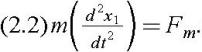
Because ? 1= dx 1/ dt, the variation of the distance x 1 of the mass from the reference point is related to F m by
Find the response (in terms of its acceleration, velocity, and position versus time) of a 3000-lb automobile to a force F i of 500 Ib, which is suddenly applied by three members of the football squad (i.e., a step change in force occurring at t=0), ignoring friction effects (see Fig. 2.3). Assume that the football players are able to maintain the applied force of 500 lb regardless of how fast the...