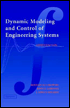
Dynamic Modeling and Control of Engineering Systems, Third Edition
2.1: INTRODUCTION

2.1 INTRODUCTION

As indicated in Chap. 1, three basic ideal elements are available for modeling elementary mechanical systems: masses, springs, and dampers. Although each of these elements is itself a system with all the attributes of a system (inputs, parameters, state variables, and outputs), the use of the term system usually implies a combination of interacting elements. In this chapter, systems composed of only mechanical elements are discussed. In addition to the translational elements (moving along a single axis) introduced in Chap. 1, a corresponding set of rotational elements (rotating about a single axis) is introduced to deal with rotational-mechanical systems and mixed (translational and rotational) systems.

Also, this chapter deals with only so-called lumped-parameter models of real mechanical systems. In certain situations, such as modeling a real spring having both mass and stiffness uniformly distributed from one end to the other, suitable lumped-parameter models can be conceived that will adequately describe the system under at least limited conditions of operation. For example, if a real spring is compressed very slowly, the acceleration of the distributed mass is very small so that all the force acting on one end is transmitted through it to the other end; under these conditions the spring may be modeled as an ideal spring. On the other hand, if the real spring is being driven in such a manner that the forces acting on it cause negligible deflection of its coils, it may be modeled as an ideal mass. When a real spring is driven...

UNLIMITED FREE
ACCESS
TO THE WORLD'S BEST IDEAS

SUBMIT
Already a GlobalSpec user? Log in.

This is embarrasing...

An error occurred while processing the form. Please try again in a few minutes.

Customize Your GlobalSpec Experience

Category: Valve Actuators
Finish!
Privacy Policy

This is embarrasing...

An error occurred while processing the form. Please try again in a few minutes.