Electronics Manufacturing: With Lead-Free, Halogen-Free, and Conductive-Adhesive Materials

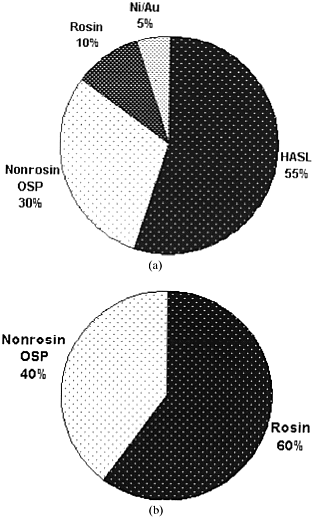
Organic solderability preservative (OSP) refers to organic coating that is applied to PCB pads as a preservative for solderability, and is also referred to as antitarnish. It includes rosins, resins, and azole chemicals.2 17 Organic solderability preservative is widely used in Japan. Depending on the PCB type, single-sided PCBs use OSP as virtually the only means for preserving solderability. For double-sided, multilayer boards, 40 percent of the surface finishes are OSP types, as shown in Fig. 14.2.18
Within the azole group, benzotriazole, imidazoles, and substituted benzimidazoles are the most popular group, and will be discussed individually. Regarding the rosin or resin, it is often referred to as preflux, and will be discussed briefly. In general, the primary benefits of OSP surface finishes are low-cost and flat-surface.
Use of benzotriazole (BTA) can be dated back to at least the early 1960s. Instead of relying on a physical layer that is mechanically applied onto the top of base-metal copper to provide protection against corrosion and oxidation, benzotriazole chemically reacts with cuprous oxide and forms polymeric copper salt, as shown in Fig. 14.3.19 These polymeric salt molecules align with each other and form a protective film composed of a semipermeable, colorless, three-dimensional polymeric layer on the surface of copper. Cuprous oxide is much faster in reacting with BTA than cupric oxides.