Electronics Manufacturing: With Lead-Free, Halogen-Free, and Conductive-Adhesive Materials

This surface finish, developed by Lucent Technology, is composed of a 100- in nickel bottom layer, a 10- in 80Pd-20Co (w/w) middle layer, and a 2- to 3- in Au top layer. All three layers are electrolytically plated. Ludwig et al. studied the solder paste reflow soldering-related performance, and the results are compared with OSP, Ni/Au, and Ni/Sn. Four lead-free solders [Sn42-Bi58 (Sn-Bi), Sn91.8-Bi4.8-Ag3.4 (Sn-Bi-Ag), Sn95.5-Ag3.8-Cu0.7 (Sn-Ag-Cu), and Sn96.5-Ag3.5 (Sn-Ag)] were used, with eutectic Sn63-Pb37 (Sn-Pb) also included as a reference. Also included in the test matrix are five fluxes, three reflow profiles, two reflow atmospheres, and two aging treatments.
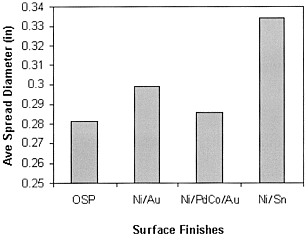
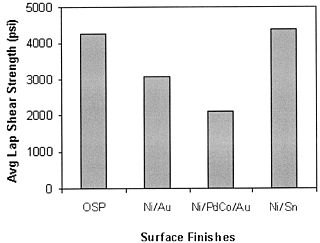
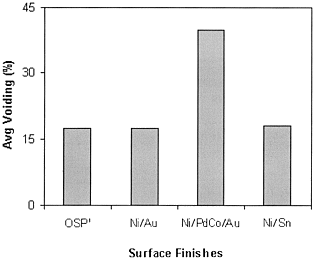
The study concluded that, overall, the Ni/PdCo/Au is poor in wettability (see Fig. 14.42), fairly low in lap shear strength (see Fig. 14.43), and high in voiding (see Fig. 14.44). However, it is fairly stable, and its soldering performance is not sensitive to profile length, reflow atmosphere, aging treatment, and flux chemistry. It does seem to be sensitive to Bi-containing alloy in terms of voiding and lap shear strength.74
Electroless PdNi alloy with a Au flash over EN is the preferred contact metallurgy, reported by Yeung and Nakamura from Hitachi Micro Systems.75 It is said to provide cost savings, extend contact life, and requires no organic lubricants. It also enhances corrosion resistance. Using this surface finish...