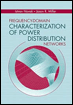
Frequency-Domain Characterization of Power Distribution Networks
Chapter 1: Introduction

The design and validation of the power distribution network (PDN) in today's electronic circuits, notably in high-speed digital equipment, is becoming an increasing challenge. The challenge can be best shown by looking at the evolution and functions of PDN.

1.1 Evolution of Power Distribution Networks

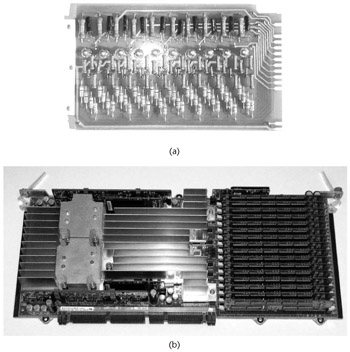
During the second half of the twentieth century, the PDN has grown from an almost nonexistent afterthought to an important subsystem. To illustrate this on computers, Figure 1.1 shows two photos side-by-side: an old and a more recent computer board. Figure 1.1(a) shows a board from the 1960s implementing a simple gate function. The discrete components in the diode-transistor-logic (DTL) circuitry were laid out on an 11 18 cm (4.3 7 inch), two-sided board. The bill of material is simple: 40 glass-encapsulated germanium diodes, two rows of 10 germanium transistors each, in metal housing, and 50 carbon resistors. The power connections are at the lower right edge of the board, but apart from the traces carrying ground and power around the devices, there is no bypass capacitor at all, and there are no planes in the stackup to serve as a signal reference. The operating frequency was probably a few hundred kilohertz. Power distribution, signal integrity (SI) of logic signals, and electromagnetic radiation was not a concern.


Figure 1.1: Illustration of digital boards (a) old and (b) new.

Figure 1.1(b) shows a central processing unit (CPU) module from a recent V890 server of Sun Microsystems [1]. The 20 50 cm (8 ...

UNLIMITED FREE
ACCESS
TO THE WORLD'S BEST IDEAS

SUBMIT
Already a GlobalSpec user? Log in.

This is embarrasing...

An error occurred while processing the form. Please try again in a few minutes.

Customize Your GlobalSpec Experience

Category: RF Attenuators
Finish!
Privacy Policy

This is embarrasing...

An error occurred while processing the form. Please try again in a few minutes.