Frequency-Domain Characterization of Power Distribution Networks

Chapter 7: Measurements: Practical Details

In Chapter 5 we covered the measurement basics, and in Chapter 6 we looked at calibrations and connections. In this chapter, we look at the practical details that are necessary to measure low impedances of PDN over wide ranges of frequencies.

7.1 Making the Proper Connections

The proper choice of calibration and probes is a necessary first step, but further considerations are needed to make sure that the connections between the VNA and probes do not impose limitations on the measurements.

7.1.1 Eliminating Cable-Braid-Loop Error at Low Frequencies

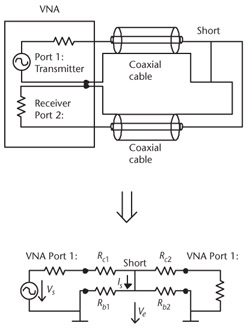
The ground returns of port 1 and port 2 in most VNAs are connected together inside the instrument. When we measure a low-impedance DUT, for instance, an active dc-dc converter output, or a metal short, the current of port 1 will create a voltage drop across the parallel equivalent of the braid resistances of the two cables. This is shown in the simplified schematics of Figure 7.1.


Figure 7.1: Simplified schematics, showing the cable-braid loop at low frequencies.

When we have a very-low-impedance device connected in the two-port shunt-through connection, the source impedance, cable center-wire resistances ( R c 1 and R c 2), and braid resistances ( R b 1 and R b 2) create a voltage divider, which produces a V e error voltage and an erroneous impedance reading floor. This divider is created as the source current flows through the parallel equivalent of the two braid resistances, raising the potential of the lower node...

UNLIMITED FREE
ACCESS
TO THE WORLD'S BEST IDEAS

SUBMIT
Already a GlobalSpec user? Log in.

This is embarrasing...

An error occurred while processing the form. Please try again in a few minutes.

Customize Your GlobalSpec Experience

Category: Thermocouple Wire
Finish!
Privacy Policy

This is embarrasing...

An error occurred while processing the form. Please try again in a few minutes.