Frequency-Domain Characterization of Power Distribution Networks
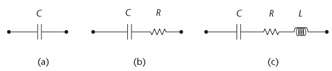
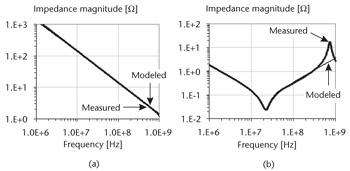
Figure 8.2 shows three of the simplest capacitor models. The parameters of the part and the frequency range of an application determine which one is acceptable. For the moment, we will assume that all elements in these equivalent circuits are frequency independent. Figure 8.2(a) is the simplest equivalent circuit: an ideal capacitor without any parasitics. Though it may look overly simplistic, there are practical situations for which this simple approximation still may be sufficient. For instance, measured data of Figure 8.3(a) shows the impedance of a small fixture in the 1-MHz-1-GHz frequency range; at first look, over three decades of frequency the impedance appears sufficiently close to that of a capacitance. We can use the ideal capacitor model because we stay below the resonance frequencies of the part. However, when the frequency range extends both below and above the series resonance frequency, we need a minimum of three components in the equivalent circuit: a capacitance, resistance, and inductance, as shown in Figure 8.2(c).
Spreadsheets are convenient to calculate and display the impedance of simple capacitor models. Figure 8.3 shows the measured and modeled impedance magnitudes of a small PCB fixture, with and...