Frequency-Domain Characterization of Power Distribution Networks
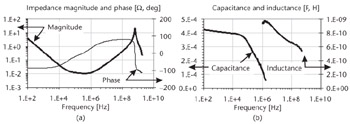
For frequency-dependent characterization and modeling, we usually need wideband measurements, which can sufficiently capture the change of capacitance at low frequencies, as well as the change of inductance at high frequencies. The first example uses a bulk capacitor. Figure 8.7 shows the results of a three-terminal facedown organic capacitor measured with two separate VNAs on a small fixture in the 100 Hz-1, 800-MHz frequency range.
Figure 8.8 shows the measured impedance magnitudes of two multilayer ceramic capacitors. Both capacitors had nominally 1- F capacitance as well as 0612 reverse-geometry form factors. The first capacitor was a regular low-ESR type; the second was a low-Q high-ESR capacitor, reported in [1]. The capacitors were soldered on a small test-fixture PCB, with approximately 2.54 2.54 cm (1 1 inch) size and a thin laminate close to the surface. To allow the measurement with one-sided probe stations, there were two pairs of vias, one on either side of the capacitor body. The distance between these via pairs was approximately 2.5 mm (100 mils). The transfer impedances between the two via pairs were measured under different conditions. First, the fixture was characterized. The impedance profile of the bare test fixture follows the static capacitance up to 1 GHz, followed by modal resonance peaks at 3.6-GHz and 8-GHz frequencies. Second, the test fixture was measured with the capacitor site shorted. Lastly, the...