Fundamentals of Carrier Transport, Second Edition
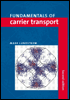
Including many homework exercises and a variety of worked examples, this book is an accessible introduction to the behavior of charged carriers in semiconductors and semiconductor devices.
 TABLE OF CONTENTS
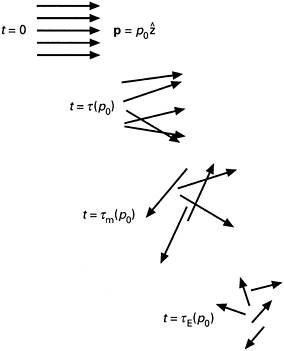
 Consider a beam of energetic carriers injected into a semiconductor at time t=0, with their momenta, p 0, aligned along the  -axis. Figure 2.1 illustrates how collisions affect such carriers. The transition rate is the rate at which carriers out-scatter from a specific initial state to a specific final state. The scattering rate,
| (2.3a) | 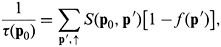 |
is the rate at which carriers with a specific momentum p 0 scatter to any other state. Alternatively, ?( p 0) is the average time between collisions (also known as the lifetime of the state, p 0). The vertical arrow below the sum is to indicate that the sum over final states includes only those whose spin is parallel to that of the incident carrier (the scattering mechanisms we consider do not flip the carrier s spin). The factor of [1 ? f (p ?)], where f (p ?) is the probability that the state at p ? is occupied, gives the probability of finding an empty final state. For a non-degenerate semiconductor, there is a high probability that the state at p ? is empty, so eq. (2.3a) becomes
| (2.3b) | 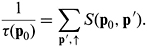 |
This sum is much easier to evaluate because it does not depend on knowing how the states are occupied.
Some important scattering mechanisms are not isotropic. Instead, they tend to deflect carriers by...