Fundamentals of Carrier Transport, Second Edition
Including many homework exercises and a variety of worked examples, this book is an accessible introduction to the behavior of charged carriers in semiconductors and semiconductor devices.
 TABLE OF CONTENTS
 To completely specify the operation of a device, we should know the state of each carrier within the device. If the carriers behave as classical particles, we should know each carrier s position and momentum as a function of time. A direct approach would consist of solving Newton s equations,
| (3.1) | 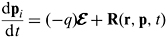 |
and
| (3.2) |  |
for each of the i=1, , N carriers in the device. In these equations p i(t) is the momentum of carrier i, r i(t) its position, and R is the random force due to impurities or lattice vibrations. Alternatively, we could ask: what is the probability of finding a carrier with crystal momentum p, at location r, at time t? The answer is f( r, p, t) where f( r, p, t), the distribution function, is a number between zero and one. To find f( r, p, t) we solve the Boltzmann Transport Equation. The distribution function describes the average distribution of carriers in both position and momentum and can be used to obtain various quantities of interest such as the carrier, current, and kinetic energy densities. Our purpose in this chapter is to derive and discuss the Boltzmann Transport Equation (BTE) and to show how it is solved to obtain the distribution function.
Before formulating an equation for f( r, p, t), let s discuss what...