Fundamentals of Carrier Transport, Second Edition

Including many homework exercises and a variety of worked examples, this book is an accessible introduction to the behavior of charged carriers in semiconductors and semiconductor devices.
 TABLE OF CONTENTS
 As discussed in Section 2.2, the perturbing potential for phonon scattering can be the deformation potential, or in polar materials there is also an electrostatic interaction. In this section we treat deformation potential scattering by nonpolar acoustic or optical phonons.
To evaluate scattering rates for acoustic phonon scattering via the deformation potential scattering, we begin with eq. (2.76) and insert eq. (2.73a) to find
| (2.81) |  |
At room temperature, the number of acoustic phonons is large, so 
 . Recalling eq. (1.134), we can invoke equipartition,
  , because ? ? s ?k B T L. With this approximation, we simplify eq. (2.81) for room temperature applications as
| (2.82) |  |
where we have used
| (2.83) | 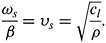 |
to relate the sound velocity, ? s, elastic constant, c l , and mass density, ?. Equation (2.82) is the sum of transitions due to acoustic phonon absorption and emission.
To evaluate eq. (2.82), we need to specify the minimum and maximum phonon wavevectors involved. From eq. (2.53), and the reasonable assumption that ADP scattering is approximately elastic near room temperature, we find that ? ? max= 2 m* ?(p) and ? ? min=0 which can be inserted in eq. (2.82) to find
| (2.84) | 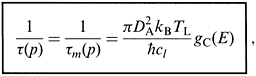 |
where g C (E) is the density of states defined in eq. (2.9). The result, which shows that the scattering rate is proportional to the number of final states available, could have...