Fundamentals of Carrier Transport, Second Edition
Including many homework exercises and a variety of worked examples, this book is an accessible introduction to the behavior of charged carriers in semiconductors and semiconductor devices.
 TABLE OF CONTENTS
 Because it is so difficult to solve the Boltzmann transport equation (BTE) directly, simpler approaches are often adopted when analyzing, designing, and optimizing devices. The use of balance, or conservation, equations which are derived from the BTE is a common approach. Balance equations have a very clear physical interpretation. For example, the electron continuity equation,
| (5.1) | 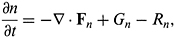 |
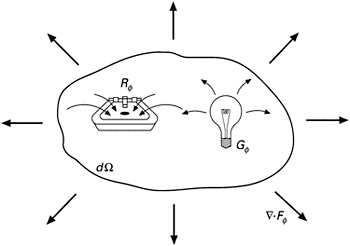
states that the net rate of increase of average carrier density at a specified location and time, n( r, t), is given by the rate per unit volume at which carriers are flowing in (the negative divergence of the electron flux, F n) plus the rate per unit volume of electron creation, G n (due to optical or avalanche generation, for example) minus the rate per unit volume at which electrons disappear (by recombining with a hole or defect). Figure 5.1 illustrates this conservation law schematically. Balance equations for the average carrier momentum and energy density can also be formulated and expressed as continuity equations in the form of eq. (5.1). Such equations find wide application in device analysis. The familiar drift-diffusion equation, for example, is a simplified form of the momentum balance equation.
This chapter begins by introducing a mathematical prescription for generating balance equations directly from the BTE. Balance equations for the average carrier density, momentum density, and energy density are then formulated. An infinite number of such equations can be generated; they are useful when only...