Fundamentals of Carrier Transport, Second Edition

Including many homework exercises and a variety of worked examples, this book is an accessible introduction to the behavior of charged carriers in semiconductors and semiconductor devices.
 TABLE OF CONTENTS
 Having identified the perturbing potential for ionized impurity scattering in Section 2.2.1, we evaluate the matrix element from eq. (2.1) as

or

According to the geometry of the scattering event (displayed in Fig. 2.2c),
| (2.33a) |  |
and
| (2.33b) | 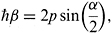 |
the latter follows from Fig. 2.2c because p= p ? for elastic scattering. With the aid of eq. (2.33a), the matrix element becomes
| (2.34) |  |
which can be integrated to find
| (2.35) ; | 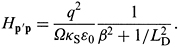 |
According to eq. (2.2), the transition rate due to scattering from a single ionized impurity is
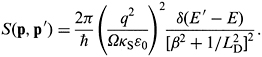
Finally, we multiply by N I ?, the number of impurities in the normalization volume, and make use of eq. (2.33b) to write
| (2.36a) | 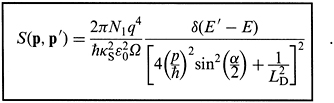 |
Equation (2.36a) describes scattering from an ionized impurity whose potential is screened by mobile carriers. When mobile carriers are absent, L D ? ? and eq. (2.36a) becomes
| (2.36b) | 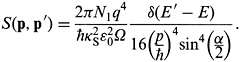 |
Equation (2.36b) applies when mobile carriers are absent which occurs, for example, in the depletion region of a p-n junction. When the carrier density is very high, L D is small so that 1/  in the denominator of eq. (2.36a) dominates. For this strongly screened case,
| (2.36c) | 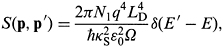 |
and the transition rate has the form of eq. (2.6) which describes scattering from a ?-function potential.
A plot of S (p, p ? ) versus ? (the polar angle between the incident and scattered momenta) is displayed in Fig. 2.5. The important point to note is that ionized ...