Fundamentals of Carrier Transport, Second Edition
Including many homework exercises and a variety of worked examples, this book is an accessible introduction to the behavior of charged carriers in semiconductors and semiconductor devices.
 TABLE OF CONTENTS
 Phonon scattering in polar semiconductors may occur from either acoustic or optical phonons. Polar acoustic phonon, or piezoelectric, scattering can be important at very low temperatures in very pure semiconductors. Scattering rates due to the piezoelectric interaction are the subject of homework problems 2.4 and 2.5. Polar optical phonon (POP) scattering, by contrast, is a very strong scattering mechanism for compound semiconductors like GaAs. It is neither elastic nor isotropic.
The scattering rate for POP scattering is found from eqs. (2.73c) and (2.76), as
| (2.89) |  |
or
| (2.90) |  |
and all that remains is to specify ? max and ? min.
To find the maximum and minimum phonon wave vectors, we set the argument of the ?-function in eq. (2.72) to zero and find a quadratic equation,
| (2.91) |  |
whose solutions give those values of ? which satisfy energy and momentum conservation for a given scattering angle ?. Solving for ? max and ? min (from ?1 ?cos ? ?+1), we find
| (2.92) | 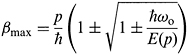 |
and
| (2.93) | 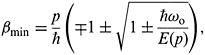 |
which are very similar to the results of Section 2.5. With these results, the POP scattering rate becomes
| (2.94) | 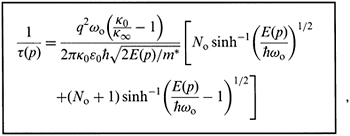 |
where the first term represents POP absorption, the second POP emission. It is understood that the second term applies only when E(p)> ? ? o, so that emission can occur. In going from eq. (2.90) to eq. (2.94), we made use of the identity

Figure 2.12 is...