Fundamentals of Carrier Transport, Second Edition
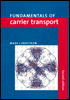
Including many homework exercises and a variety of worked examples, this book is an accessible introduction to the behavior of charged carriers in semiconductors and semiconductor devices.
 TABLE OF CONTENTS
 The first step is to identify the perturbing potential responsible for scattering, so that the matrix element can be evaluated. In this section, we identify the perturbing potentials for the most common scattering mechanisms, ionized impurity and phonon scattering. In following sections, the transition and scattering rates will be evaluated, and some additional mechanisms will be considered.
Carriers are scattered when they encounter the electric field of an ionized impurity. We might assume that the scattering potential is Coulombic,
| (2.10) | 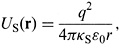 |
but the ionized impurity attracts mobile carriers which screen the potential. The electrostatic potential due to both the ionized impurity and mobile carriers is found by solving Poisson s equation in spherical coordinates,
| (2.11) |  |
where an n-type semiconductor has been assumed. Space charge neutrality dictates that n=n 0 =  (with a corresponding electrostatic potential of V= V 0) on a macroscopic scale, but on a microscopic scale, perturbations in the potential and carrier density exist. By writing the potential and carrier density as V= V 0+ ?V and n=n 0 + ?n and substituting in eq. (2.11), we find
| (2.2) | 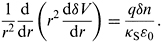 |
To find ?n, recall that

for a non-degenerate semiconductor and that

so small perturbations in carrier density can be related to perturbations in the potential by
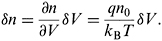
After inserting this result in Poisson s equation, we find
| (2.13) |  |
where
| (2.14) | 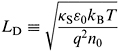 |
is known as the Debye length. [For degenerate semiconductors, Fermi-Dirac statistics apply, and...