Fundamentals of Engineering Examination Review 2001-2002 Edition

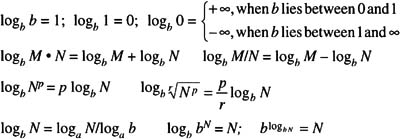
Definition. If b is finite positive number, other than 1, and b x = N, then x is the logarithm of N to the base b, or log b N = x. If log b N = x, then b x = N.
Common (Briggsian)-base 10.
Natural (Napierian or hyperbolic)-base 2.7183 (designated by e or ?).
The abbreviation of "common logarithm" is "log," and the abbreviation of "natural logarithm" is "In."
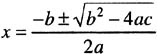
if ax 2 + bx + c = 0, then
If b 2 ? 4 ac > 0, the roots are real and unequal; if b 2 ? 4 ac = 0, the roots are real and equal; if b 2 ? 4 ac < 0, the roots are imaginary.
An arithmetic progression is a, a + d, a + 2d, a + 3d, ..., where d = common difference.
The nth term is t n = a + ( n ? 1) d
The sum of n terms is ![]()
A geometric progression is a, ar, ar 2, ar 3, ..., where r = common ratio.
The nth term is t n = ar n?1