Fundamentals of Engineering Examination Review 2001-2002 Edition

This chapter reviews the basic knowledge and working tools required to pass the thermodynamics portion of the Fundamentals of Engineering (FE/EIT) exam. It excludes areas of thermodynamics not normally included on the exam.
Typical solved problem are grouped at the end of this chapter and are referred to in the text section of the review material.
Except for nuclear physics, involving the conversion of mass into energy, mass is conserved in a process. In thermodynamics, the mass in a closed system (such as a piston-cylinder) is constant. In an open system, where mass is flowing in and out, the sum of the mass flowing into the system equals the mass flowing out if there is no accumulation of mass within the system. This is called conservation of mass.
Energy is also conserved and must be accounted for. The types of energy that are important in thermodynamics are the following:
Internal energy
Flow energy
Kinetic energy
Potential energy
Heat
Work
The first four energy types are a function of the state or condition of the substance. Heat and work are forms of energy which cross the boundary of systems and are not a function of the state.
The first law of thermodynamics is a bookkeeping system to keep track of these energies.
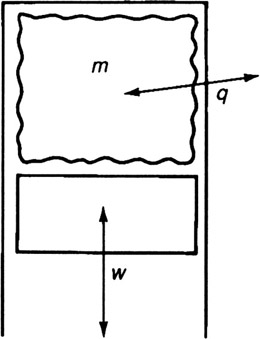
For a typical closed thermodynamic system (Fig. 11-1), the kinetic and potential energy are not important, and since there is no flow, the bookkeeping is simple and reduces to