Fundamentals of Engineering Examination Review 2001-2002 Edition

Mechanics of materials deals with the determination of the internal forces (stresses) and the deformation of solids such as metals, wood, concrete, plastics and composites. In mechanics of materials there are there main considerations in the solution of problems:
Equilibrium
Force-deformation relations
Compatibility
Equilibrium refers to the equilibrium of forces. The laws of statics must hold for the body and all parts of the body. Force-deformation relations refer to the relation of the applied forces to the deformation of the body. If certain forces are applied, then certain deformations will result. Compatibility refers to the compatibility of deformation. Upon loading, the parts of a body or structure must not come apart. These three principles will be emphasized throughout.
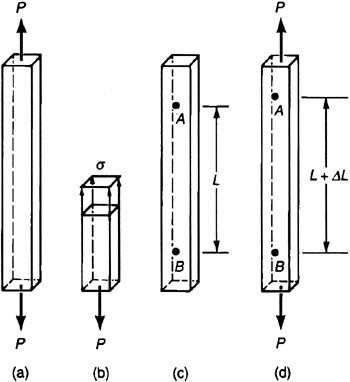
If a force P is applied to a member as shown in Fig. 9-1(a), then a short distance away from the point of application the force becomes uniformly distributed over the area as shown in Fig. 9-1(b). The force per unit area is called the axial or normal stress and is given the symbol ?. Thus,
The original length between two points A and B is L as shown in Fig. 9-1(c). Upon application of the load P, the length L grows by an amount ? L. The final length is L + ? L as shown in Fig. 9-1(d). A quantity measuring the intensity of deformation and being...