Handbook of Coastal Engineering

HENRY BOKUNIEWICZ
Marine Science Research Center
State University of New York
Stony Brook, New York
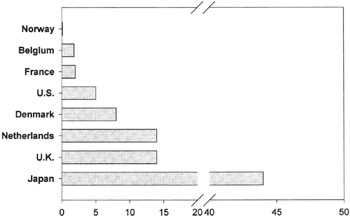
Offshore, submerged marine aggregates consist primarily of sand and gravel, but mined marine resources can include boulders, clays, marl, shell, and shingle. Marine aggregates have been mined in most countries of northern Europe, as well as in Canada, the United States, Japan, and the city of Hong Kong (Figure 18.3). Japan recovers 80 million tons (44 million m 3) per year, making her the leader in world production (Narumi, 1989, as cit-ed in Smith and Collis, 1993). The United Kingdom and the Netherlands are other large producers. Over 15% of the demand for mined aggregates in United Kingdom are met with offshore resources. This can amount to almost 24 million tons (19 million m 3) per year. Denmark also obtains 10 to 15% of its needs from offshore resources (ICES, 1992).
The reasons for turning to marine aggregates can be both economic and environmental. In some regions, land-based deposits may coincide with good agricultural land but in many cases development pressures are incompatible with active land-based sand mining because of noise, dust, and transport traffic (Smith and Collis, 1993). Land-based operations unavoidably alter landscape, change terrestrial habitats, and can threaten groundwater. Marine aggregate mining,...