JOHN R.C.HSU
Department of Environmental Engineering,
University of Western Australia,
Nedlands, Western Australia, Australia
TAKAAKI UDA
Public Works Research Institute,
Ministry of Construction,
Tsukuba, Ibaraki, Japan
RICHARD SILVESTER
Department of Civil Engineering,
University of Western Australia,
Nedlands, Western Australia, Australia
1. INTRODUCTION
Japan, where the East meets West, and the past greets the present, is located at the fringe of the northeastern Asiatic continent. The Japanese landform is dominated by mountainous terrain in the center and narrow, low-lying sandy strips scattered along its edges (Figure 9.1). Traditionally, the Japanese economy has depended heavily on agriculture, for which rice paddy fields were created from reclaimed tidal flats plus coastal lagoons and low-lying river deltas. Since the Meiji era (1868 1912), modernization has seen industrial activities expand throughout the entire country, with factories and population crowding the narrow coastal strips (Koike, 1988).
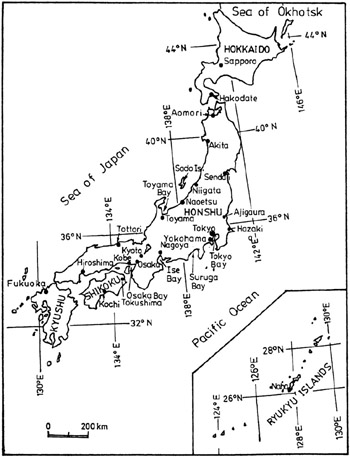 Figure 9.1: Location of Japan, showing the four main islands and those of Ryukyu, plus major cities and bays.
 The island nation of Japan has been subjected to frequent attacks of natural disasters, including typhoons, storm surges, tsunamis, and earthquakes. The low-lying coastal areas are susceptible to coastal flooding, caused by various meteorological, geomorphological, and oceanographical conditions. One of the worst natural disasters was the storm surge produced by Ise Bay typhoon, which killed 5,041 people on September 26, 1959 (Iwagaki, 1994). As such, Hom-ma and Horikawa (1960) once stated about coastal protection works and related problems in Japan that: Japan has been utilizing the coastal areas to an utmost extent...
Copyright The McGraw-Hill Companies, Inc. 2000 under license agreement with Books24x7

 TABLE OF CONTENTS