Handbook of Coastal Engineering

LINEAR WAVE THEORY

Description

This application yields first-order approximations for various parameters of wave motion as predicted by the wave theory bearing the same name (also known as small amplitude, sinusoidal, or Airy theory). It provides estimates for engineering quantities such as water surface elevation, general wave properties, particle kinematics, and pressure as functions of wave height and period, water depth, and position in the wave form.

Introduction

The effects of water waves are of major importance in the field of coastal engineering. Waves are a major factor in determining geometry and composition of beaches and significantly influence planning and design of harbors, waterways, shore protection measures, coastal structures, and other coastal works.

In general, actual water-wave phenomena are complex and difficult to describe mathematically because of nonlinearities, three-dimensional characteristics, and apparent random behavior. The most elementary wave theory, referred to as small-amplitude or linear wave theory, was developed by Airy (1845). This nomenclature derives from the simplifying assumptions of its derivation. Additionally, it represents a first approximation resulting from a formal perturbation procedure for waves of finite amplitude.

General Assumptions and Limitations

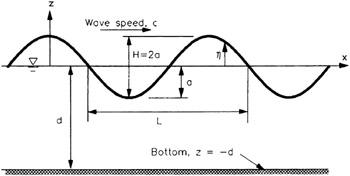
A typical representation of a wave is depicted in Figure 2 1 1.


FIGURE 2 1 1: Progressive wave.

Common terminology for wave discussions includes the following:

  • d=still-water depth

  • ?=free surface elevation relative to still water ( z=0)

  • a=wave amplitude

  • H=wave height=2 a for small-amplitude waves

  • L=wavelength

  • T=wave period

  • c=velocity of wave propagation (celerity)= L/T

  • k=wave number=2 ?/L

UNLIMITED FREE
ACCESS
TO THE WORLD'S BEST IDEAS

SUBMIT
Already a GlobalSpec user? Log in.

This is embarrasing...

An error occurred while processing the form. Please try again in a few minutes.

Customize Your GlobalSpec Experience

Category: Ultrasonic Transducers
Finish!
Privacy Policy

This is embarrasing...

An error occurred while processing the form. Please try again in a few minutes.