I.1 : Definition and Purpose of HVAC Systems
Heating, ventilating, and air conditioning (HVAC) is defined as the simultaneous control of temperature, humidity, radiant energy, air motion, and air quality within a space for the purpose of satisfying the requirements of comfort or a process. Not included in the definition, but often required, is control of the pressure in the conditioned space relative to adjacent areas. Another factor which becomes important in many applications is the noise level associated with the air conditioning equipment.
Most people equate air conditioning with cooling but, as the definition states, air conditioning is a great deal more than that. Comfort must also be defined a difficult task because the sensation of comfort is subjective and varies with the individual and the level of activity. Cleanliness relates to the broad subject of indoor air quality, which includes not only dust and dirt but also gaseous contaminants, viruses, and bacteria.
It becomes quickly evident that to accomplish true air conditioning is not all that simple, and in some industrial or institutional applications, it may be very difficult. Not unlike medicine, HVAC is part art and part science.
The purpose of this book is to discuss various air conditioning design procedures and systems and to give the reader the tools necessary to understand and solve many air conditioning problems. For simplicity, the acronym HVAC (heating, ventilating, and air conditioning) is used unless only one of these factors is being discussed. Throughout the book, frequent...

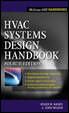
 TABLE OF CONTENTS