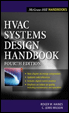
HVAC Systems Design Handbook, Fourth Edition
Chapter 21: Indoor Air Quality

21.1 Background

The concept of indoor air quality (IAQ) is not new. Publications as far back as the early 1800s discuss the subject and suggest ventilation as the solution. These early writers mostly recommended a minimum of 5ft 3/min of outdoor air per person, but later writers increased that number. The present ASHRAE Standard 62 value is 20 ft 3/min for normal situations.

Most of this early work was done in England, where a number of public buildings were provided with heating and ventilating systems, including the House of Commons. Centrifugal fans were developed, using small steam engines for motive power. Schools were a prime target for ventilation, and by the early part of the twentieth century the schoolroom unit ventilator was developed and advertised. Electric motors were available by then. A three-story elementary school, built in 1916, included an outdoor air-ventilation system with a direct current motor-driven supply fan (rheostat control provided manual variable volume!) and cast iron steam-heating coils in the ventilation air for winter use. When the new science of air cooling came along, the value of introducing outdoor air through the cooling/heating system was obvious. And, as the material in the previous parts of this book shows, present technology allows us to control outdoor air ventilation very accurately.

But there is a great deal more to improving IAQ than simply using outdoor air. Outdoor air is not necessarily better than indoor air, and simple ventilation is not enough. We must also control humidity;

UNLIMITED FREE
ACCESS
TO THE WORLD'S BEST IDEAS

SUBMIT
Already a GlobalSpec user? Log in.

This is embarrasing...

An error occurred while processing the form. Please try again in a few minutes.

Customize Your GlobalSpec Experience

Category: Breathing and Ventilation Air Systems
Finish!
Privacy Policy

This is embarrasing...

An error occurred while processing the form. Please try again in a few minutes.