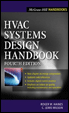
HVAC Systems Design Handbook, Fourth Edition
The purpose of this chapter is to outline the criteria used in the HVAC system and equipment selection process, to describe some of the systems and equipment available, and to develop some of the underlying philosophy and background related to system selection.
Details of specific systems and items of equipment are discussed in later chapters.
The problem-solving process requires some criteria that can be applied in describing and evaluating alternatives. In the selection of HVAC systems, the following criteria (Table 4.1) are used consciously or unconsciously because only rarely is the problem-solving process formally applied.
| 1. Demands of comfort or process 2. Energy conservation, code requirements 3. First cost versus life-cycle cost 4. Desires of owner, architect, and/or design office 5. Space limitations 6. Maintainability/reliability 7. Central plant versus distributed systems 8. Simplicity and controllability |
1. Requirements of comfort or process. These requirements include temperature, always; humidity, ventilation, and pressurization, sometimes; and zoning for better control, if needed. In theory at least, the comfort requirement should have a high priority. In practice, this criterion is sometimes subordinated to first cost or to the desires of someone in authority. This is happening less often as building occupants become more sophisticated in their expectations. Process requirements are more difficult and require a thorough inquiry by the HVAC designer into the process and its needs. Until the process is fully under- stood, the designer cannot...